Problem
Investor communication mattered, but each update still depended on scattered source material, manual memory, context switching, research, and recurring effort.
Product management proof
I built an n8n workflow that turned investor updates from a multi-day manual process into a one-hour review-and-approve loop.
Problem
Investor communication mattered, but each update still depended on scattered source material, manual memory, context switching, research, and recurring effort.
What I owned
I built the repeatable n8n system that orchestrated source gathering, current-events research, context synthesis, draft production, and human review.
Result
Every two weeks, the team could run the workflow, review a source-aligned newsletter draft, approve it, and send it without rebuilding the process.
Certain identifying details, credentials, and investor-facing materials have been omitted or generalized to preserve confidentiality.
Stakeholders wanted more regular contact from the team. The hard part was not writing one update. The hard part was producing a good update every two weeks without rebuilding the process each time.
That sounds simple until the work becomes recurring: someone has to gather the latest source material, remember which conversations matter, check what was happening in the market, turn messy updates into a coherent note, and keep the cadence alive while the team is still building.
The risk was not that we lacked things to say. The risk was that investor communication would become another high-intent workflow that depended on manual energy every time it needed to happen.
The point was to stop treating each newsletter like a fresh manual project. If regular communication mattered, the system needed to generate the next update from the business context of that specific two-week period.
I treated the newsletter as an investor-relations workstream, not just a writing task. The team needed a repeatable way to pull together company signal, stakeholder conversations, market context, and draft structure so regular updates became easier to produce without lowering the quality bar.
I took ownership of the repeatable system behind the communication cadence: orchestration, source gathering, current-events research, source incorporation, synthesis, draft production, review points, and task capture. The goal was not to replace investor-relations judgment. It was to make sure that judgment started from current evidence instead of a blank page.
The product question was practical: what would make the right update easier to create the next time?
I built a production n8n workflow that connected Google Calendar, Fireflies, Tavily, OpenAI, Google Docs, Notion, and Gmail into a newsletter-generation system.
The workflow:
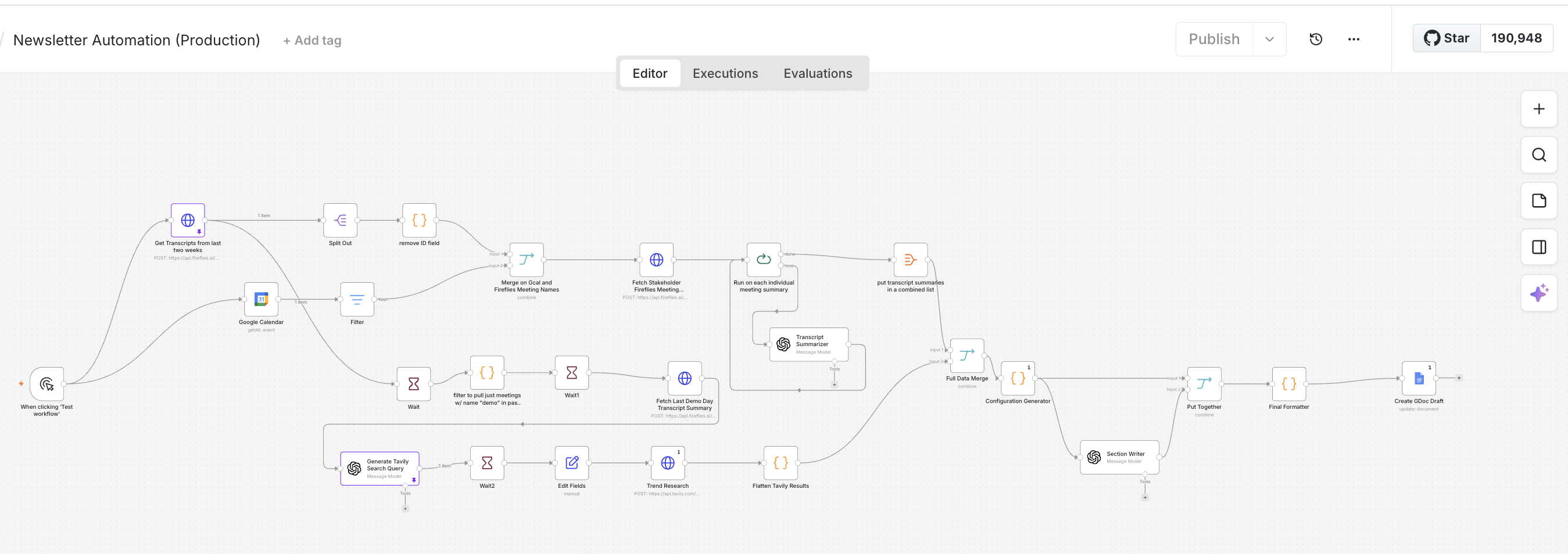
Investor communication is part of operating discipline. A regular update is not valuable because it exists on a calendar. It is valuable when it helps stakeholders understand what the team is learning, where traction is emerging, and which questions still matter.
The workflow made that discipline easier to sustain. Every two weeks, it could pull the team’s recent business context, query relevant current events, draft a custom newsletter, and preserve review before anything went out.
That review point mattered. The workflow did the orchestration, research, source gathering, source incorporation, and draft production. The human task became review, approve, and send.
In practical terms, it made stakeholder communication easier for the team to keep alive while still preserving human control over the message.
The automation turned a recurring communication intention into a full investor-relations workstream. It gave the team a repeatable path from raw business context to draft newsletter: source material, research, synthesis, editing, task capture, and send preparation.
The stronger proof is that the system stayed dynamic. The team did not need to manually update the whole setup for each cycle; the workflow generated a custom, source-aligned newsletter from the business context of that two-week period.
The hardest part of a recurring communication workflow is not the send button. It is keeping the update connected to real evidence without making the process so heavy that the team avoids it.
Automation helps when it protects the cadence and gathers the raw material. Judgment still belongs in deciding what the update should mean.