Problem
Customer conversations were happening, but the learning risked becoming anecdotal, hard to compare, and too easy to lose when product, GTM, and fundraising decisions competed for attention.
Product management proof
Across 100+ customer conversations and user interviews, I designed the learning loop, conducted interviews, built an n8n transcript-synthesis workflow, and handed source-grounded insights to Pier's technical cofounder.
Problem
Customer conversations were happening, but the learning risked becoming anecdotal, hard to compare, and too easy to lose when product, GTM, and fundraising decisions competed for attention.
What I owned
I routed transcripts by conversation type, designed structured extraction prompts, added schema validation and human review, and connected the resulting insight repository to product, positioning, and engineering decisions.
Result
Pier gained a reusable customer-intelligence system instead of relying on scattered transcripts, one-off notes, or one person's memory of each call.
Customer details and source records have been generalized to protect private relationships.
Pier was building an AI-assisted product for qualification and evaluation workflows. Employers and other workflow participants could provide rich signal about what evidence they trusted, where decisions stalled, and what the product needed to make clearer. Raw transcripts, however, could not become the team’s memory or roadmap.
The product-management problem was not producing more notes. It was designing a learning loop that could preserve the source, distinguish conversation types, extract decision-relevant signal, and move that signal into product, positioning, and engineering work.
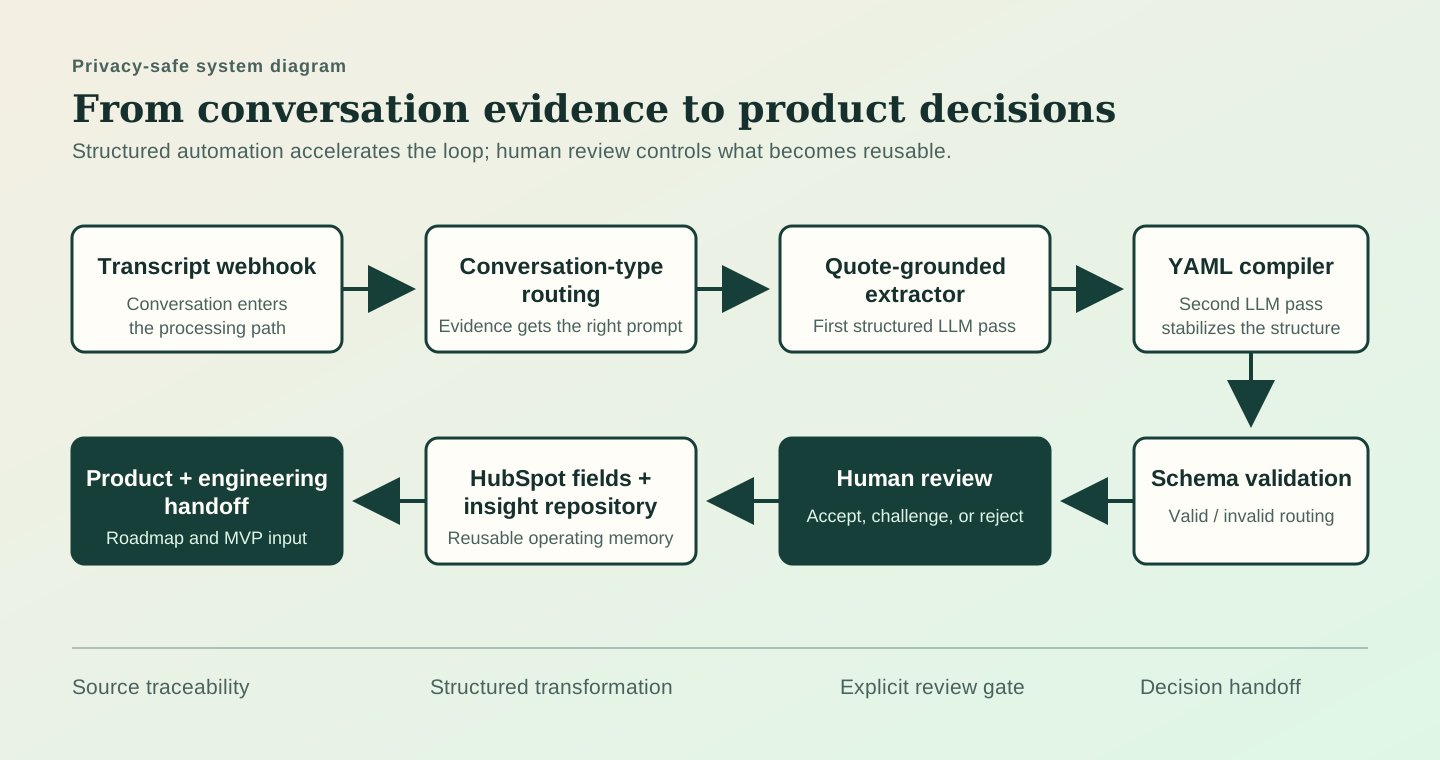
I designed the learning loop and conducted the interviews. I then built the technical path that turned transcripts into reviewable customer intelligence: conversation-type routing, a first LLM pass for quote-grounded extraction, a second pass that compiled the findings into a stable YAML structure, schema validation, valid-or-invalid routing, and human review before the result could change a source-of-truth document.
I also organized the accepted outputs in a versioned repository and handed the insights to Pier’s technical cofounder for MVP feature decisions.
The decision was not to produce one confident summary from every call. A user interview, buyer conversation, and partner discussion were different evidence types, so they needed different extraction prompts and review standards.
The workflow prioritized source traceability over fluent prose. Each retained finding needed direct transcript support, and outputs that failed the schema or review standard stayed out of the learning repository. That made the handoff inspectable rather than turning customer language into an untraceable list of feature requests.
The operating version used webhook-triggered orchestration to start transcript processing. The saved n8n export shows the core analysis path: transcript intake, quote-grounded extraction, YAML compilation, schema validation, and valid-or-invalid output routing. HubSpot fields and the versioned insight repository made the accepted learning reusable in the team’s operating work.
Across 100+ customer conversations and user interviews, Pier gained a repeatable way to turn raw transcripts into source-grounded customer intelligence. The accepted insights were organized for reuse and handed to the technical cofounder as input to product, positioning, and MVP feature decisions.
Customer discovery becomes product work when another person can inspect the signal, challenge the interpretation, and use it in a real decision. Technical automation made that loop faster and more consistent; source grounding and human review kept the decision accountable.