Problem
A procurement and subcontractor-activation direction sounded promising, but broad language like AI for procurement would have hidden the real workflow and created unsupported claims.
Product management proof
I narrowed a broad procurement idea into a bounded subcontractor-activation workflow with concrete states, supported claims, and human decision authority.
Problem
A procurement and subcontractor-activation direction sounded promising, but broad language like AI for procurement would have hidden the real workflow and created unsupported claims.
What I owned
I mapped the work to pre-contract subcontractor activation: intake, missing documents, insurance and compliance checks, readiness tracking, follow-up, handoffs, and human sign-off.
Result
I turned a broad procurement idea into a bounded subcontractor-activation test. The eight-contact cohort produced no replies or booked meetings, so I recommended pausing rather than scaling the campaign.
Certain buyer examples, target details, and internal artifacts have been summarized or generalized.
The vendor-procurement experiment started with a question that could have become too broad quickly: should Pier test a procurement or subcontractor activation direction instead of staying inside hiring-led positioning?
The useful product work was narrowing that question. Vendor procurement was the umbrella. The actual workflow we could reason about was pre-contract subcontractor activation: the gap between a subcontractor being selected and being ready to mobilize.
That gap had a specific shape. It was not an abstract market label. It was forms, missing documents, insurance and compliance checks, readiness items, follow-up, unclear ownership, and handoffs from procurement to field operations.
I helped make the workflow specific enough to test. The work involved intake forms, missing documents, insurance and compliance checks, readiness items, repeated follow-up, unclear ownership, and handoffs from procurement to field operations.
If we described that as AI for procurement, we would lose the real workflow. If we described it as autonomous approval, we would overclaim.
So the product decision was a claim-boundary decision: make the workflow specific enough to test, and keep the story inside what the evidence could support.
This is workflow mapping in product-management terms. Before a product can automate or assist a workflow, the PM has to understand the job, the states, the handoffs, the claims the product can support, and where human judgment still belongs.
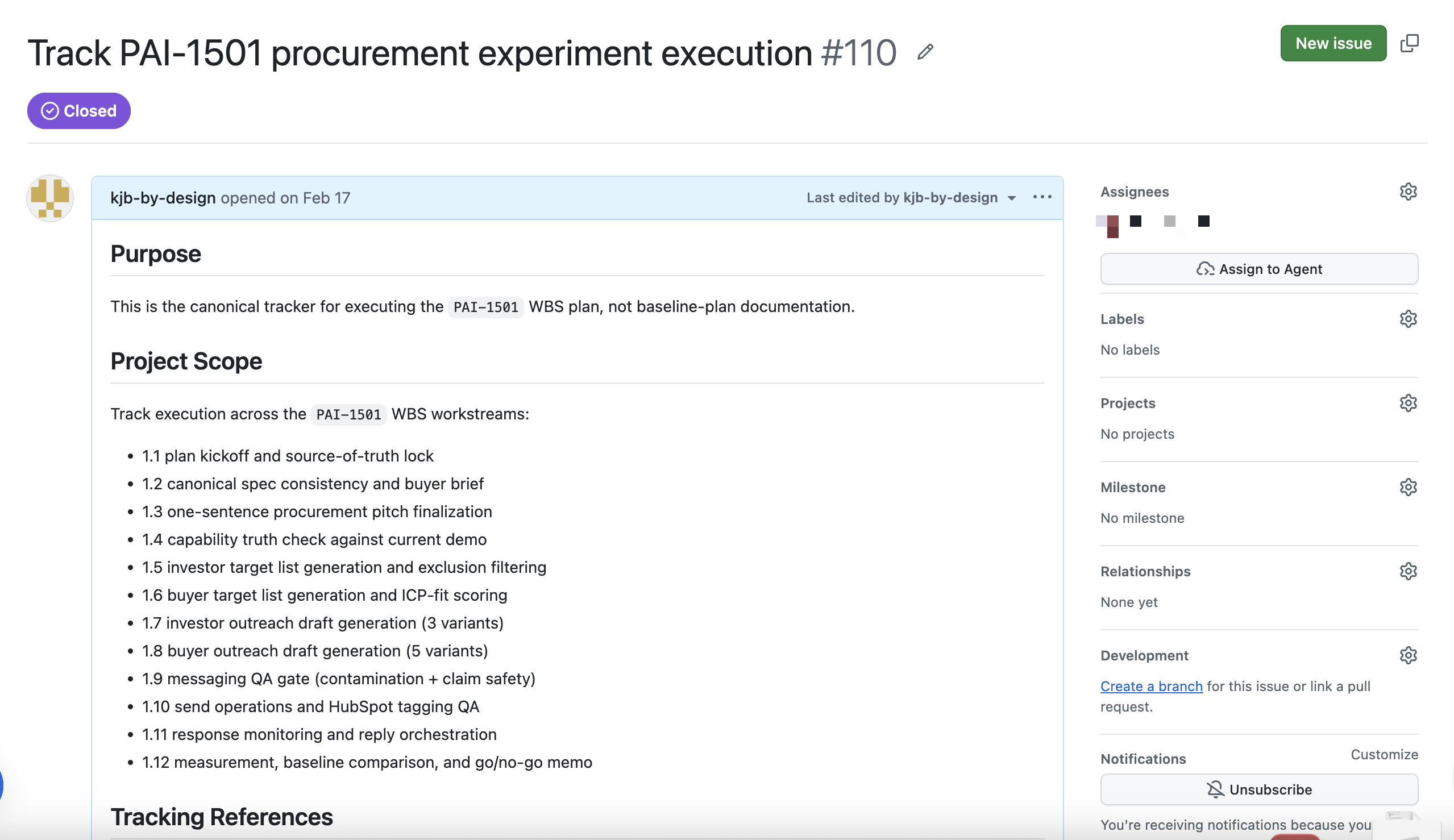
The bounded construction thesis became the basis for an external validation test. I designed the 12-stage workflow, set the human review gates, and took an eight-contact cohort through send execution.
The cohort produced no replies or booked meetings. I treated that null result as evidence: the positioning had not earned more time, money, or narrative commitment, so I recommended pausing rather than scaling the campaign.
Agentic workflows become safer when the workflow is concrete first. Autonomy is not the starting point. The starting point is understanding the states, failure modes, evidence, and human decision boundary.