Problem
A public-sector tender needed pricing, delivery assumptions, partner boundaries, and external credibility to line up under intense deadline pressure.
Product management proof
We had roughly 48 hours to structure and submit a custom public-sector bid for a 15,000-application program, so I used AI-agent workflows and git-managed business docs to help move the work from concept to submission.
Problem
A public-sector tender needed pricing, delivery assumptions, partner boundaries, and external credibility to line up under intense deadline pressure.
What I owned
I used AI-agent workflows and git-managed business docs to model delivery scenarios, define pricing and partner boundaries, and assemble the submission package.
Result
The team submitted a coherent custom bid package on deadline for a potential 15,000-application program.
Certain identifying details and artifacts have been omitted or generalized to preserve confidentiality.
The opportunity arrived as a firedrill. We had roughly 48 hours to structure and submit a custom public-sector bid for using the product in a 15,000-application program.
The work was more than document production. Pricing, delivery assumptions, partner boundaries, and external credibility all had to line up before the package could leave the building.
The opportunity involved a potential delivery volume of up to 15,000 applications, multiple operating scenarios, and a delivery partnership that needed clear commercial boundaries.
The scale made the work unforgiving. A vague price, loose delivery assumption, or unclear partner boundary could have made the whole opportunity look less credible.
We were able to move that quickly because the business documents already lived in git-managed workflows, and because AI-agent workflows could help turn the source material, pricing logic, and submission requirements into reviewable drafts fast enough for human decisions.
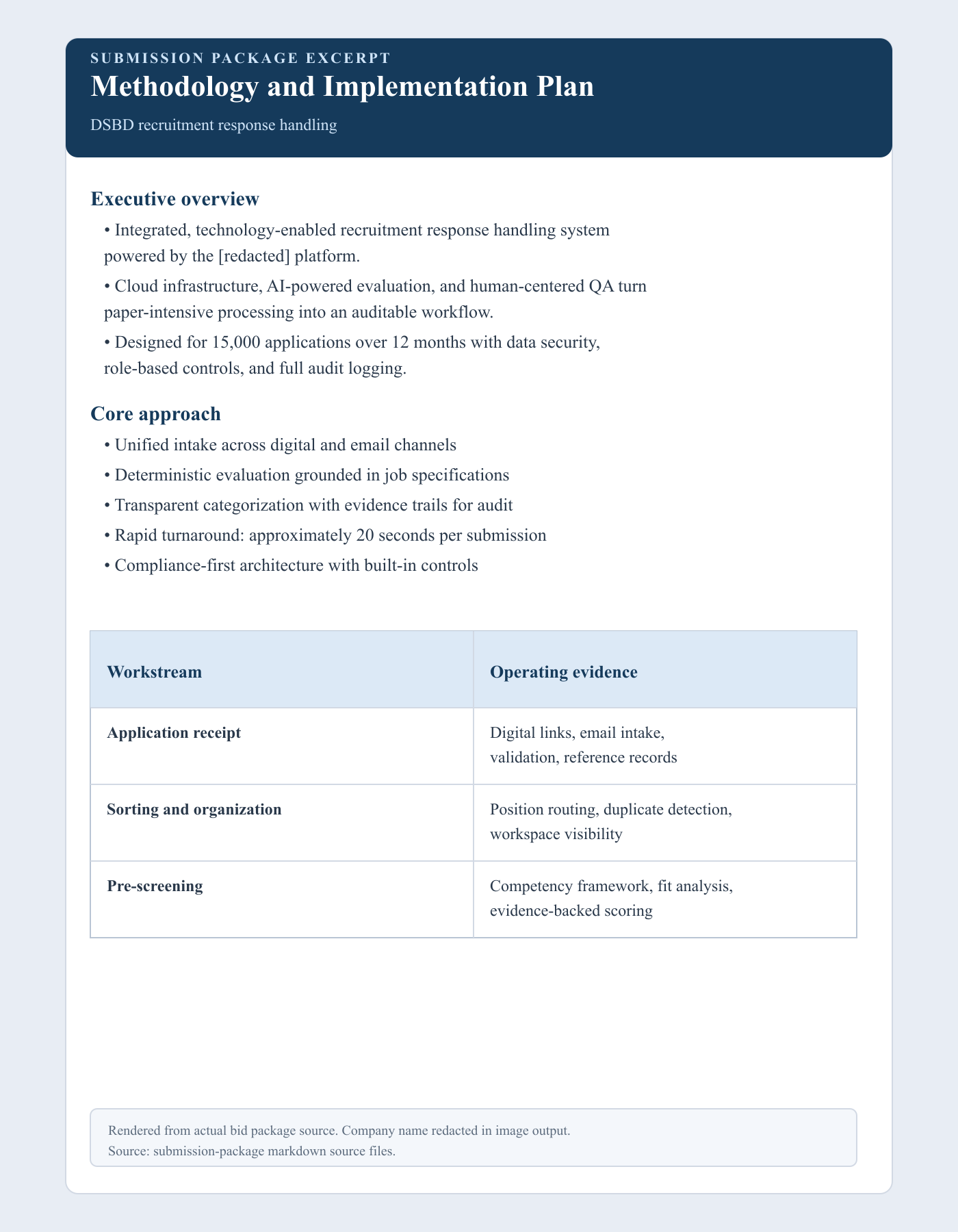
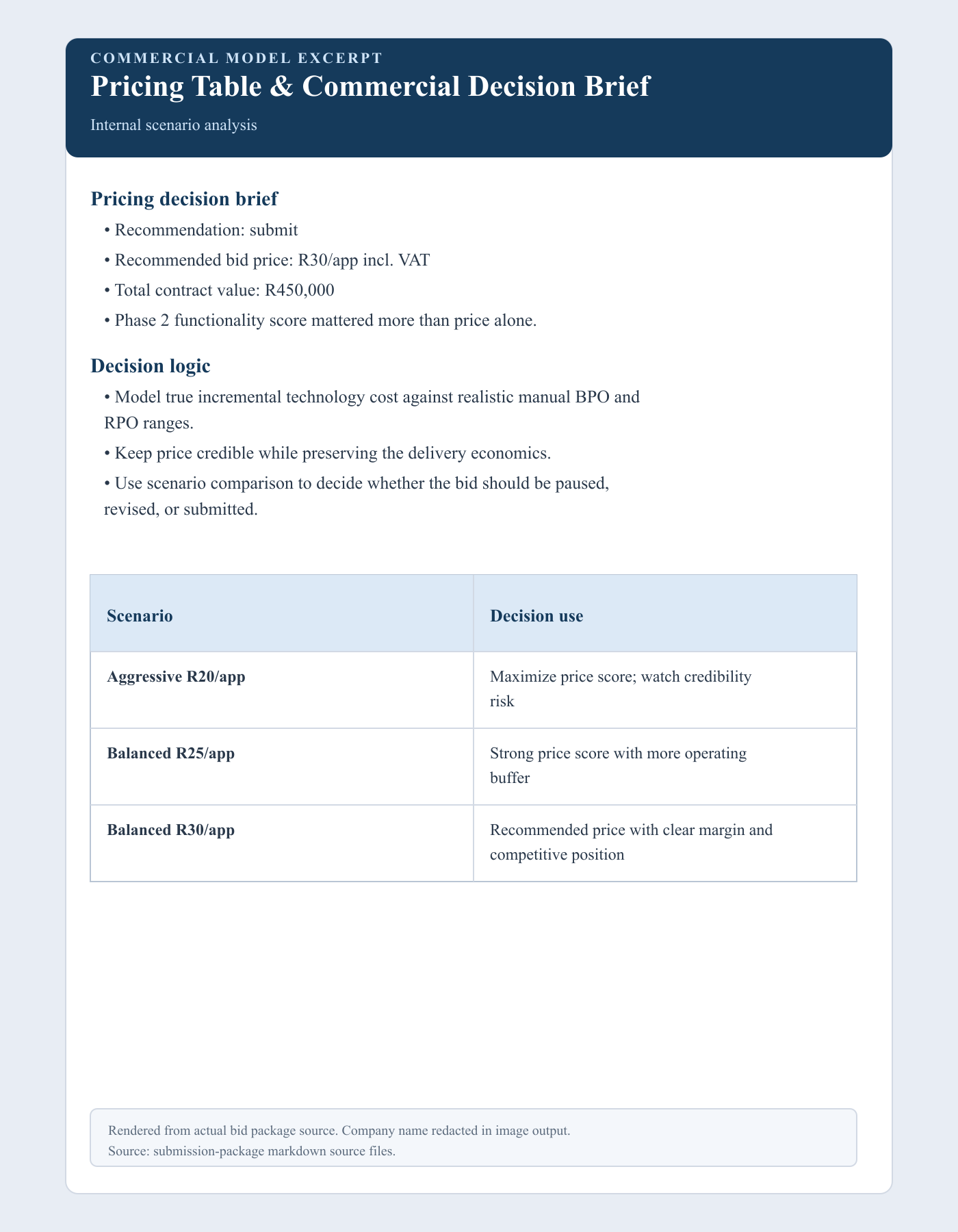
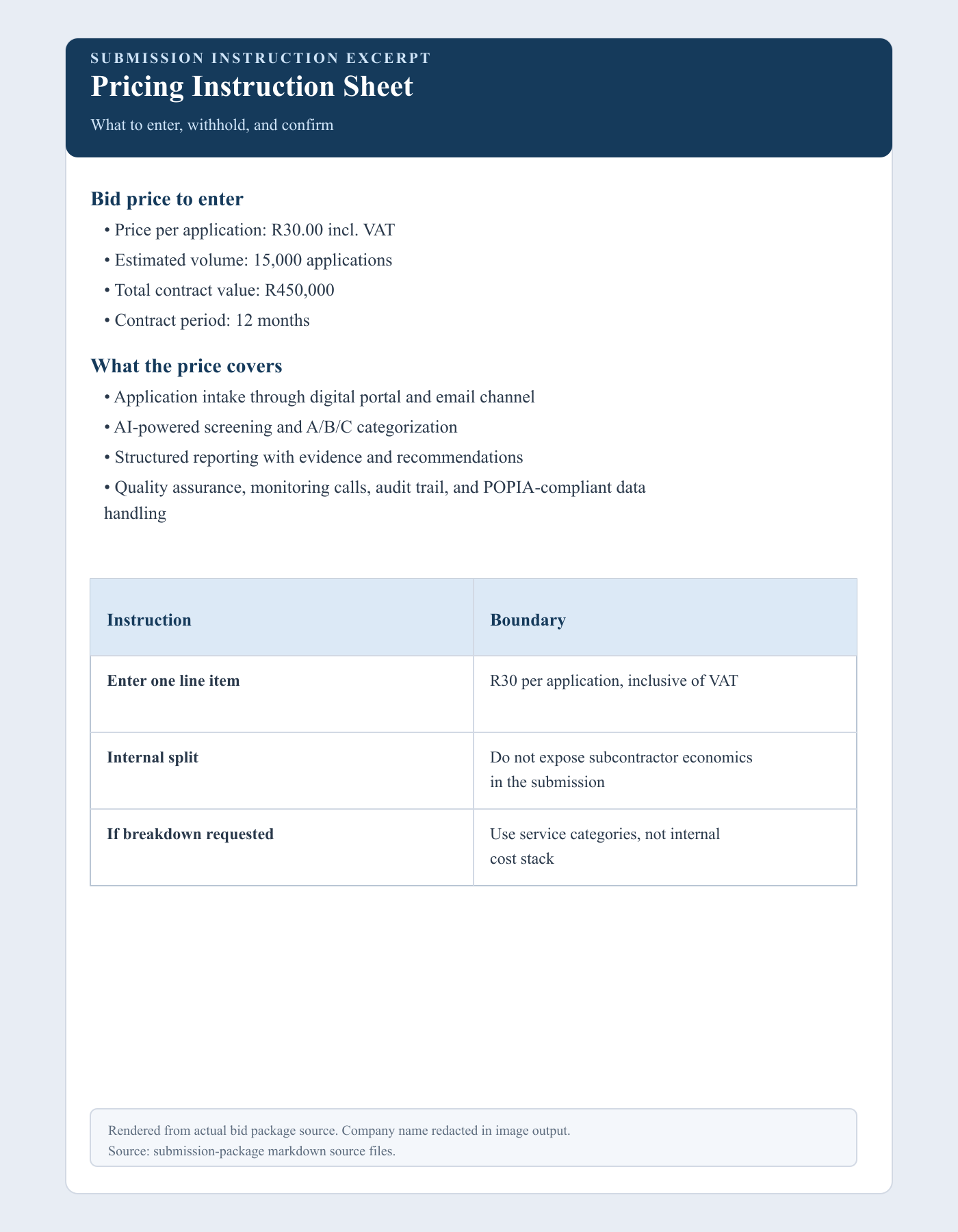
I translated the opportunity into a decision-ready commercial package. That required modeling the operating scenarios, defining pricing and delivery boundaries, coordinating submission materials, and structuring the proposed partnership terms.
AI-agent workflows and git-managed business docs mattered because they made the bid work parallel and reviewable. The agents helped move source material into drafts, and the git-managed document workflow kept changes, assumptions, and review points legible under deadline pressure.
I took ownership of the commercial spine of the bid. The work was not just filling out a tender response; it was making sure the economics, partner responsibilities, and delivery assumptions could survive external scrutiny.
My job was to make the commercial logic sturdy enough to leave the building. The model and the submission package had to tell the same story about what we could deliver, under which assumptions, and where the boundaries were.
The work required structured decision-making under deadline pressure: quantifying scenarios, defining commercial limits, and converting analysis into a coherent external package.
That is the executive skill this case study shows: turning a time-sensitive opportunity into a package that could be evaluated by people outside the team. The submission had to be coherent enough that outside reviewers could evaluate the opportunity without needing the internal context behind every assumption.
We completed and submitted the tender package on deadline. Our local delivery contact responded positively to the quality of the materials. We did not receive a final contract decision from the government, so the commercial outcome remains unknown.
Under deadline pressure, a financial model is most useful when it clarifies which decisions remain negotiable and which boundaries need to stay fixed. The analysis and the external package have to reinforce the same commercial logic.