Problem
Procurement and subcontractor-activation positioning sounded more fundable than the prior hiring-led story, but the team needed external signal before shifting commitment.
Product management proof
I built a human-in-the-loop agent workflow that ran a procurement market validation test and proved a reusable way to test future customer and market questions.
Problem
Procurement and subcontractor-activation positioning sounded more fundable than the prior hiring-led story, but the team needed external signal before shifting commitment.
What I owned
I built a bounded validation play with a hypothesis, source-of-truth tracker, agent runbook, human review gates, response monitoring, and baseline comparison.
Result
The null result became a decision asset, and the workflow proved a reusable way to run future customer and market validation tests.
Certain identifying details and artifacts have been omitted or generalized to preserve confidentiality.
The first signal was a gap between plausibility and evidence. A procurement and subcontractor-activation angle sounded strategically promising, especially after external feedback made the hiring-led story look less obviously fundable. But a better-sounding story was still not market signal.
That created a practical question: did the new positioning generate stronger external signal than the current path, or was it only more attractive inside the room?
I did not want the team to confuse a plausible story with a validated market signal. The useful question was smaller and harder: what evidence would change our next allocation decision?
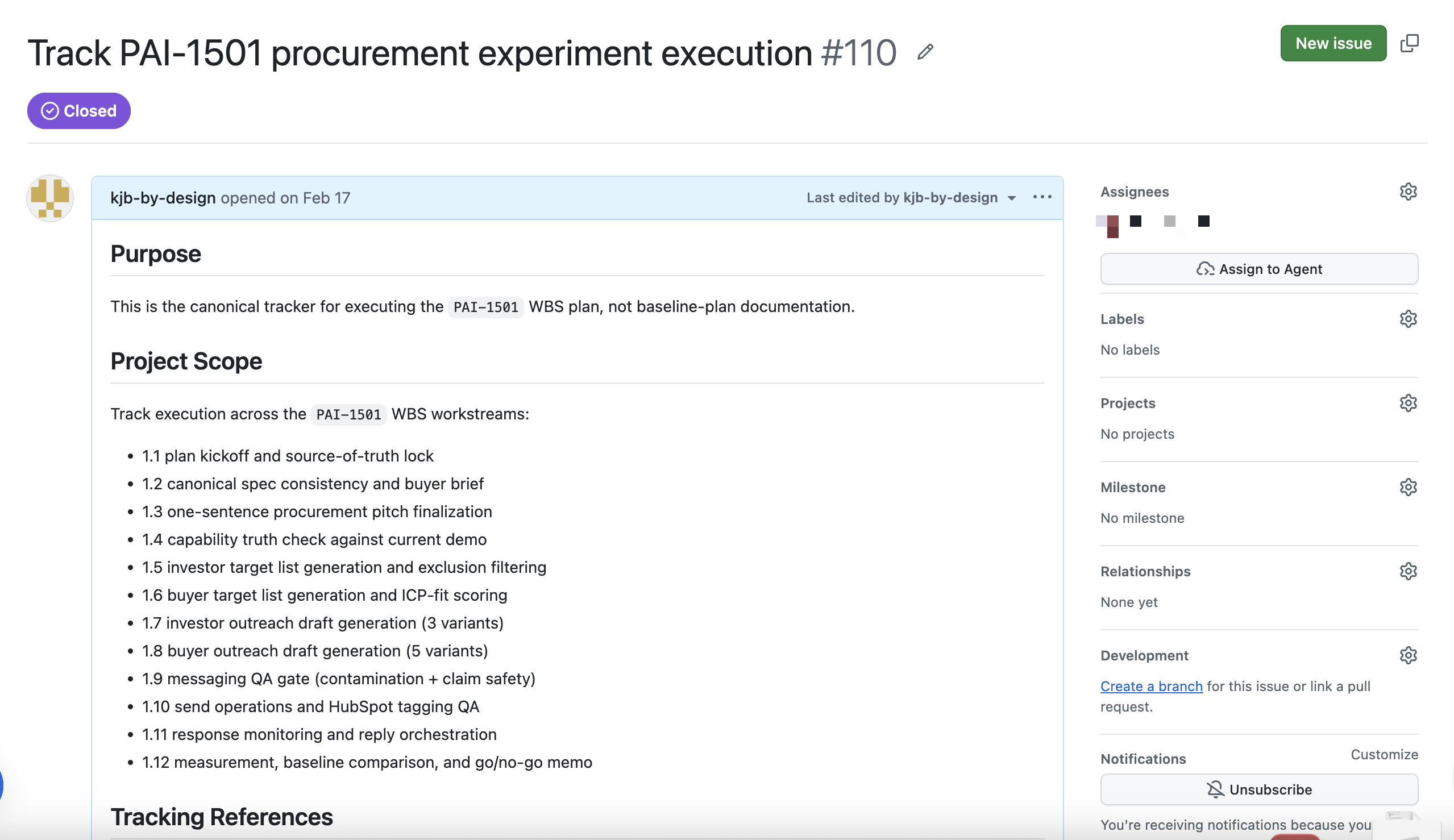
I designed a bounded market-validation experiment rather than relying on an informal outreach push. The important move was not simply using AI faster. I built the workflow so the agent did most of the execution work: research the segment, maintain the tracker, prepare targets, draft and improve messages, monitor response signal, and preserve the evidence needed for the final allocation decision. My role was to design the system, review the outputs, approve the externally facing pieces, and decide what the result meant.
The discipline was in making the market experiment small enough to run and strict enough to interpret. A weak response should mean something, not just create another reason to keep trying.
I turned the question into a decision process: define the hypothesis, identify the smallest credible cohort, set the review standard, and decide in advance what kind of response would justify broader investment.
The work became more disciplined in the second pass. I used deterministic task tracking, a synced work-breakdown tracker, and explicit opening and closing notes for the major work items. That mattered because the experiment was part of a larger founder loop: product evidence, investor feedback, and market validation all needed to resolve into a shared commitment decision.
The workflow decomposed the experiment into 12 stages, from hypothesis definition and target selection through message refinement, verification, and launch. Human-in-the-loop agent operations fed response monitoring and baseline comparison so the play ended in an explicit recommendation rather than activity for its own sake.
That structure mattered because speed alone would have been misleading. If AI made the experiment faster but less reviewable, it would have weakened the evidence instead of improving it.
The experiment turned a broad strategic question into a controlled learning loop. The objective was not outreach volume. It was to test whether procurement positioning produced decision-useful signal and whether that signal should change product, market, or fundraising commitment.
That gave the team a cleaner basis for action. Instead of debating whether the positioning sounded plausible, we could inspect a reviewed market test and decide whether the signal had earned more resources.
The verified eight-contact cohort produced no replies or booked meetings. That null result was useful: it provided an early signal that the positioning did not yet justify a broader outreach campaign and reduced the risk of scaling an untested hypothesis.
I treated the null result as a decision asset. It gave us a reason not to spend more time, money, or narrative energy on a positioning angle that had not yet earned it, and it supported a clear recommendation to pause rather than scale the campaign.
AI can increase the speed of an experiment without lowering the quality bar, but only when the workflow makes review points explicit. For early market validation, a small verified cohort and a clear null result can be more useful than a larger campaign.
The deeper lesson was about operating discipline. A validation play is only as useful as its ability to feed the next decision. The tracker, gates, and baseline comparison mattered because they kept the work tied to commitment quality instead of letting it become another outreach activity metric.